孙银光:华中师范大学教育学院副教授、道德教育研究所专职研究员

李 璐:华中师范大学道德教育研究所2024级硕士生

张晓轩:华中师范大学道德教育研究所2024级博士生
陈晓雯:华中师范大学道德教育研究所2024级硕士生
邓诗弋:华中师范大学道德教育研究所2024级硕士生
胡晓玲:华中师范大学道德教育研究所2024级硕士生
Abstract
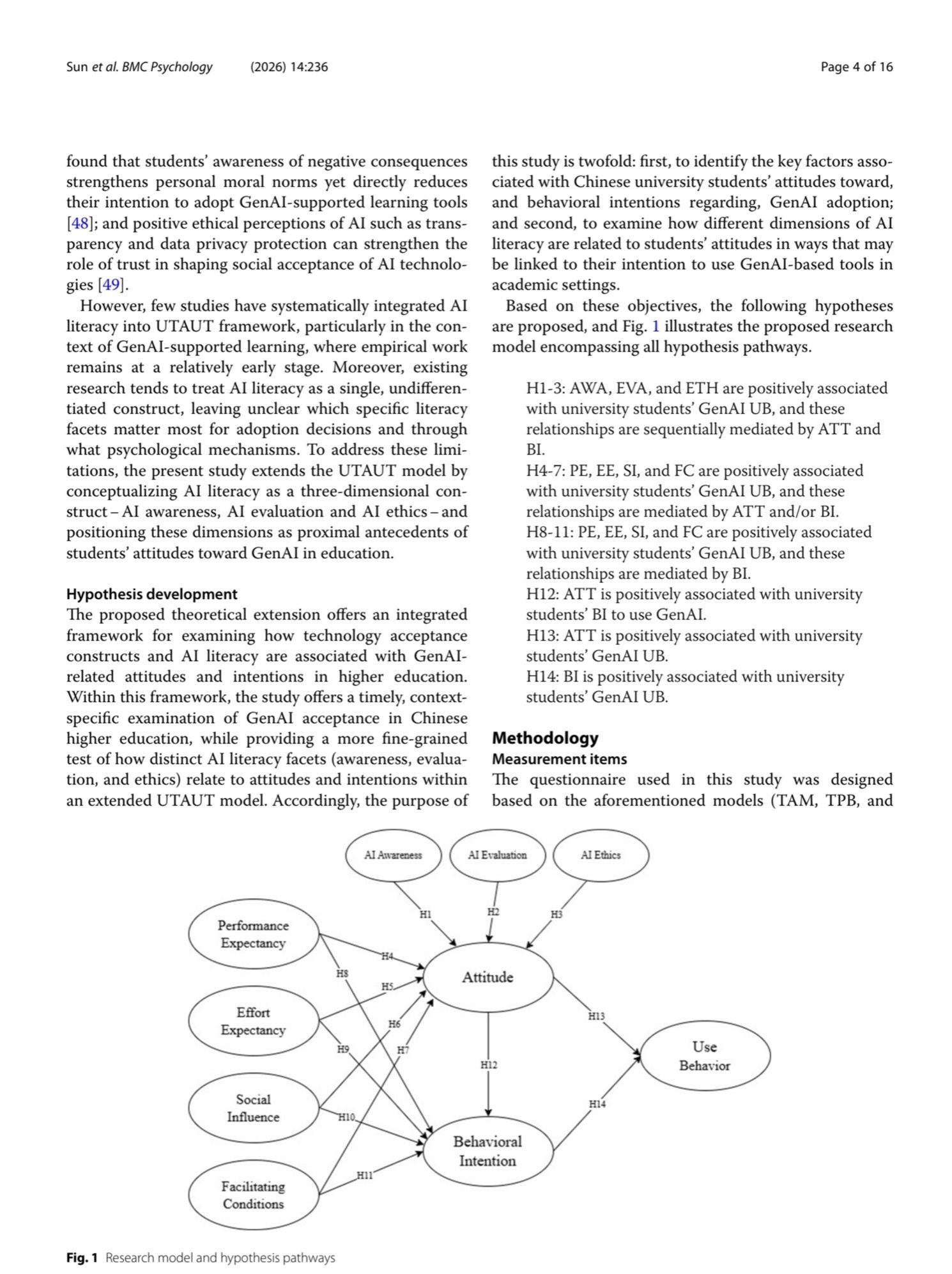
Background Generative artificial intelligence (GenAI) is reshaping higher education by influencing students’ learning, cognition, and academic decision-making. Understanding the factors that associated with students’ acceptance of this technology is crucial for its successful integration. This study extends the Unified Theory of Acceptance and Use of Technology (UTAUT) by incorporating attitude as a mediator and AI literacy as an antecedent to investigate psychological factors associated with GenAI adoption among Chinese university students.
Method A cross-sectional survey design was employed. Data were collected from 1,536 Chinese university students via an online questionnaire. The instrument included validated scales measuring AI literacy (awareness, evaluation, ethics), UTAUT constructs (performance expectancy, effort expectancy, social influence, facilitating conditions), attitude, behavioral intention, and use behavior. Partial least squares structural equation modeling (PLS-SEM) was used to test the hypothesized relationships.
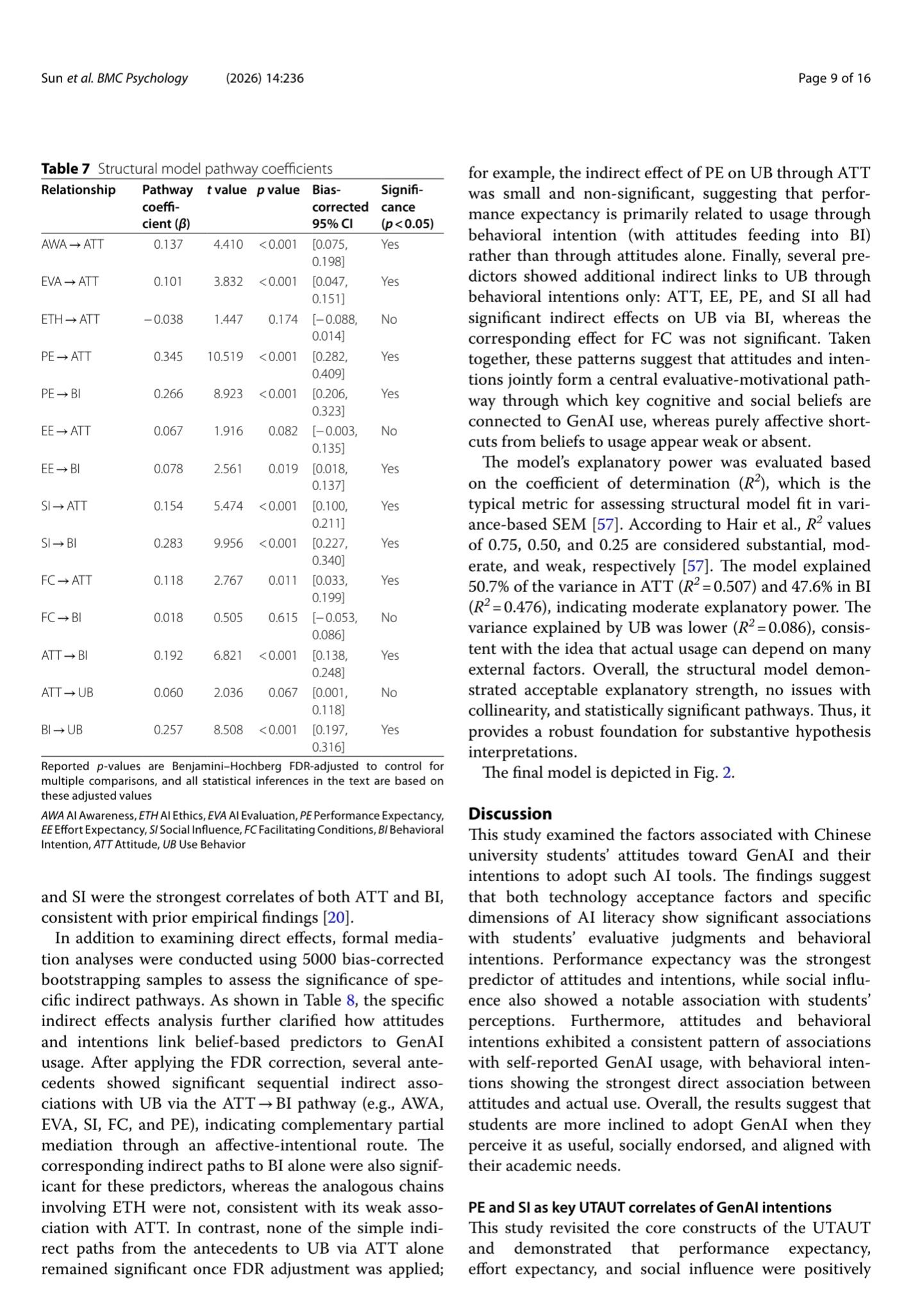
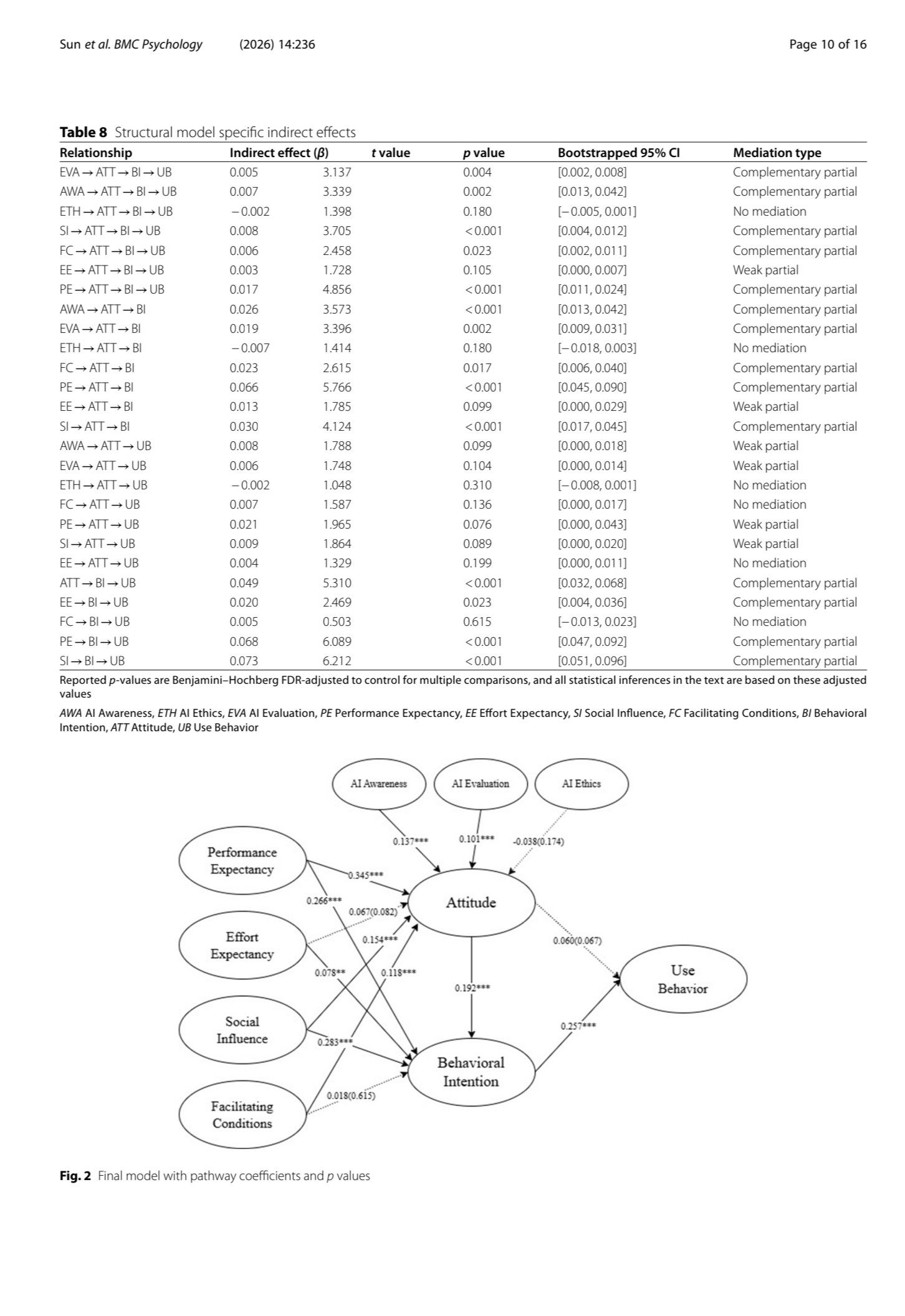
Results Performance expectancy (β = 0.345, p < 0.001), social influence (β = 0.154, p < 0.001), and facilitating conditions (β = 0.118, p < 0.05) were positively correlated with students’ attitudes toward GenAI. Performance expectancy (β = 0.266, p < 0.001), effort expectancy (β = 0.078, p < 0.05), and social influence (β = 0.283, p < 0.001) were linked to behavioral intention. Attitude was positively associated with behavioral intention (β = 0.192, p < 0.001), whereas its direct association with use behavior was small and non-significant after FDR correction (β = 0.060, p > 0.05); instead, behavioral intention showed a strong positive association with use behavior (β = 0.257, p < 0.001). Among AI literacy dimensions, awareness (β = 0.137, p < 0.001) and evaluation (β = 0.101, p < 0.001) were positively associated with attitudes, while ethics demonstrated a non-significant negative relationship (β = − 0.038, p = 0.148). The model explained 50.7% of the variance in attitude and 47.6% in behavioral intention.
Conclusions The findings presented herein highlight the relevance of AI awareness, evaluative competence, performance expectancy, and social endorsement for understanding students’ positive evaluations and intentions regarding GenAI use. Attitude emerges as a central affective correlate that connects these cognitive appraisals with students’ reported behavioral intentions. Taken together, these patterns may inform efforts to design AI literacy initiatives in university curricula and supportive learning environments that emphasize informed awareness, critical evaluation, and ethical reflection, thereby fostering more psychologically informed and responsible engagement with GenAI in higher education.
摘要:
研究背景生成式人工智能(GenAI)正深刻重塑高等教育,影响着学生的学习、认知与学术决策。了解与学生接受该技术相关的因素,对其成功融入教学至关重要。本研究扩展了技术接受与使用统一理论(UTAUT),将态度作为中介变量、AI 素养作为前因变量,探究与中国大学生使用生成式 AI 相关的心理因素。
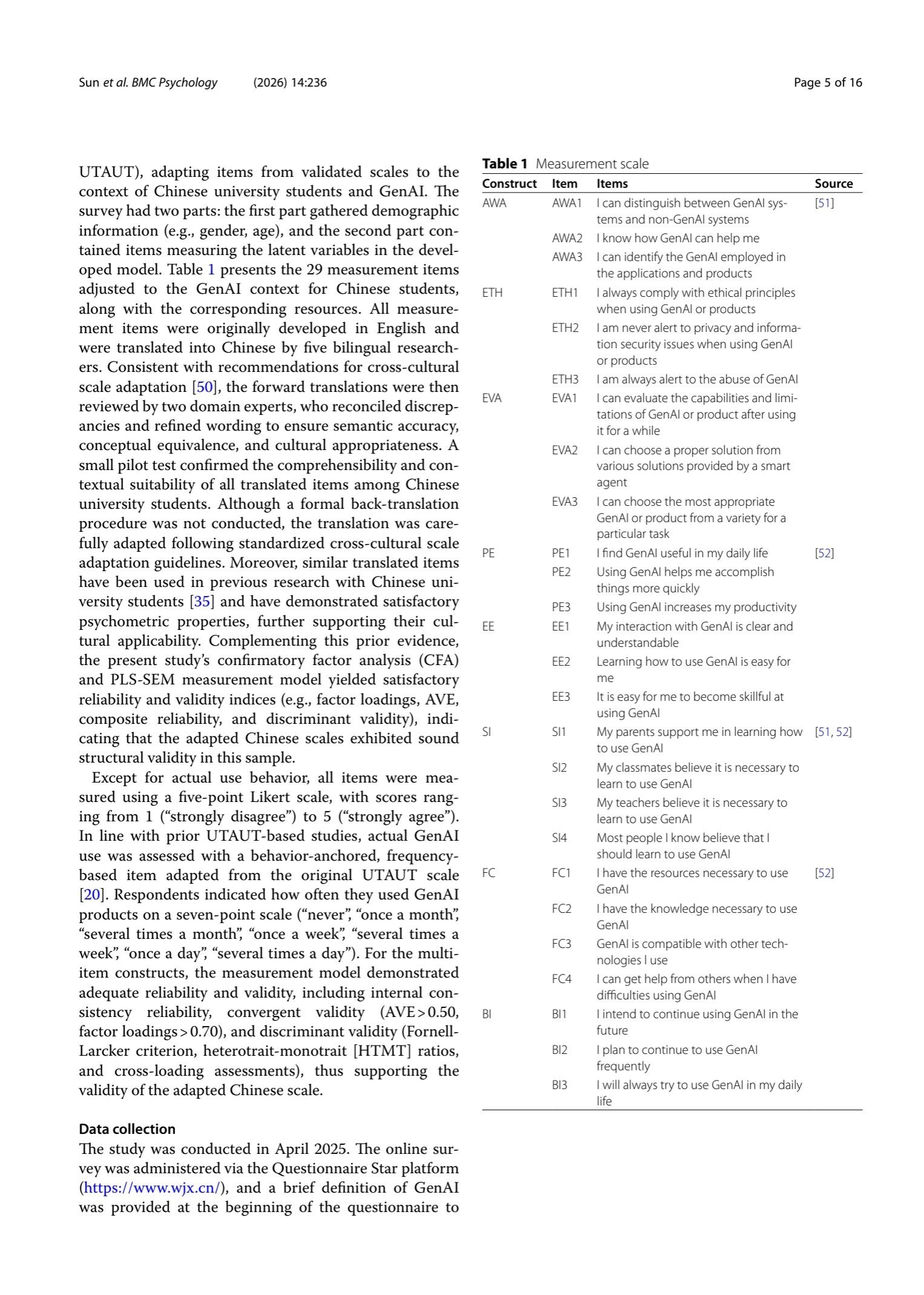
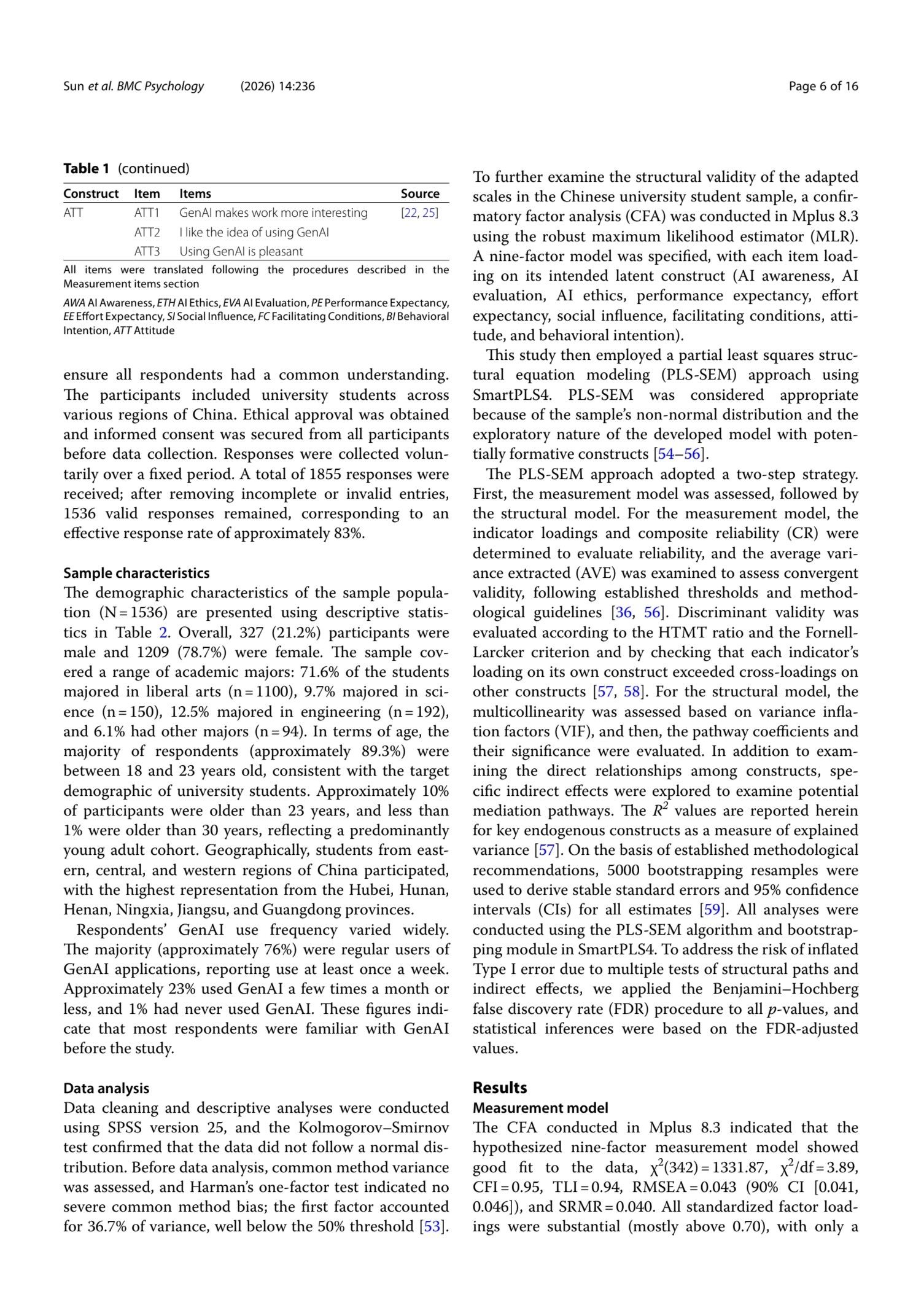
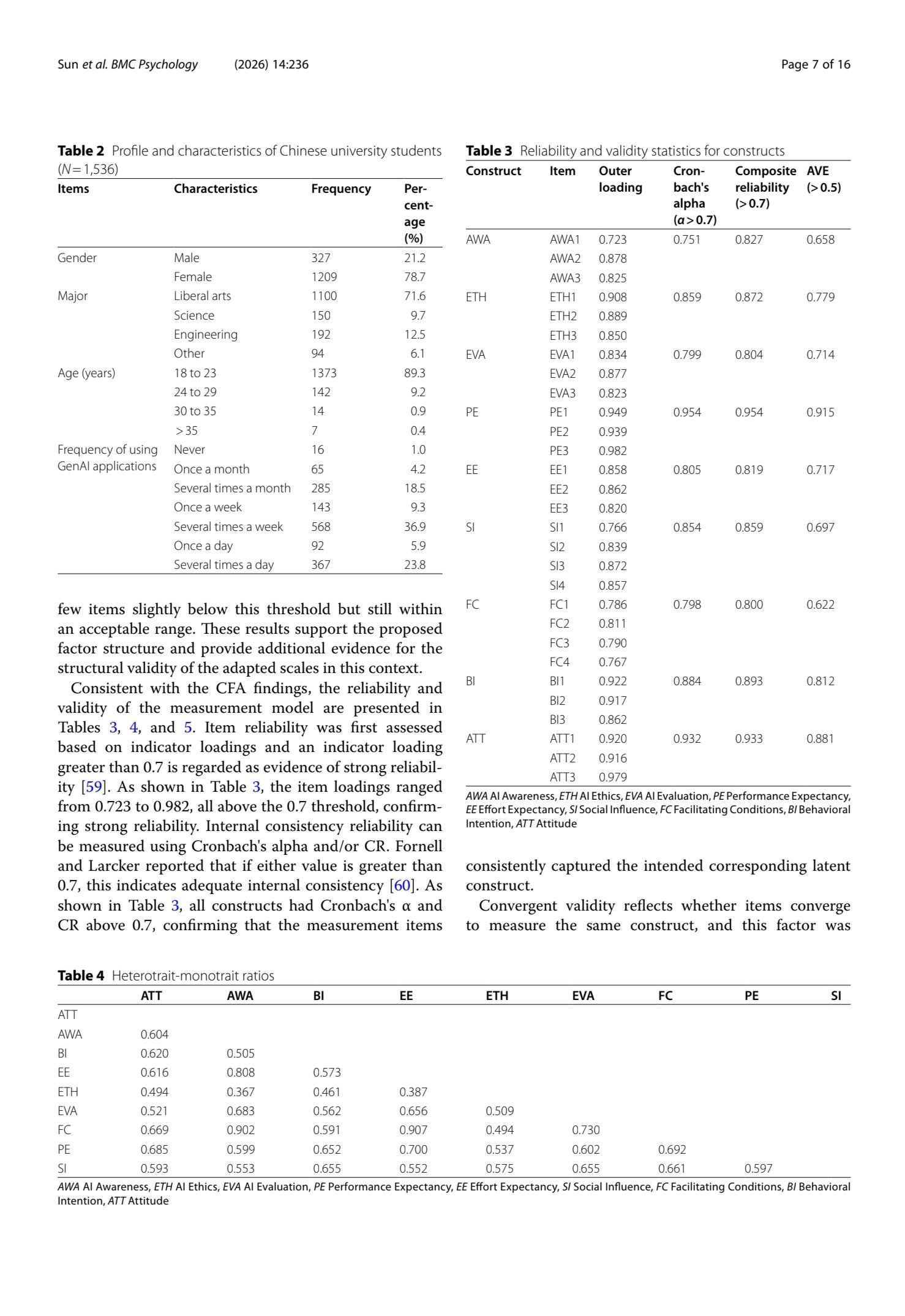
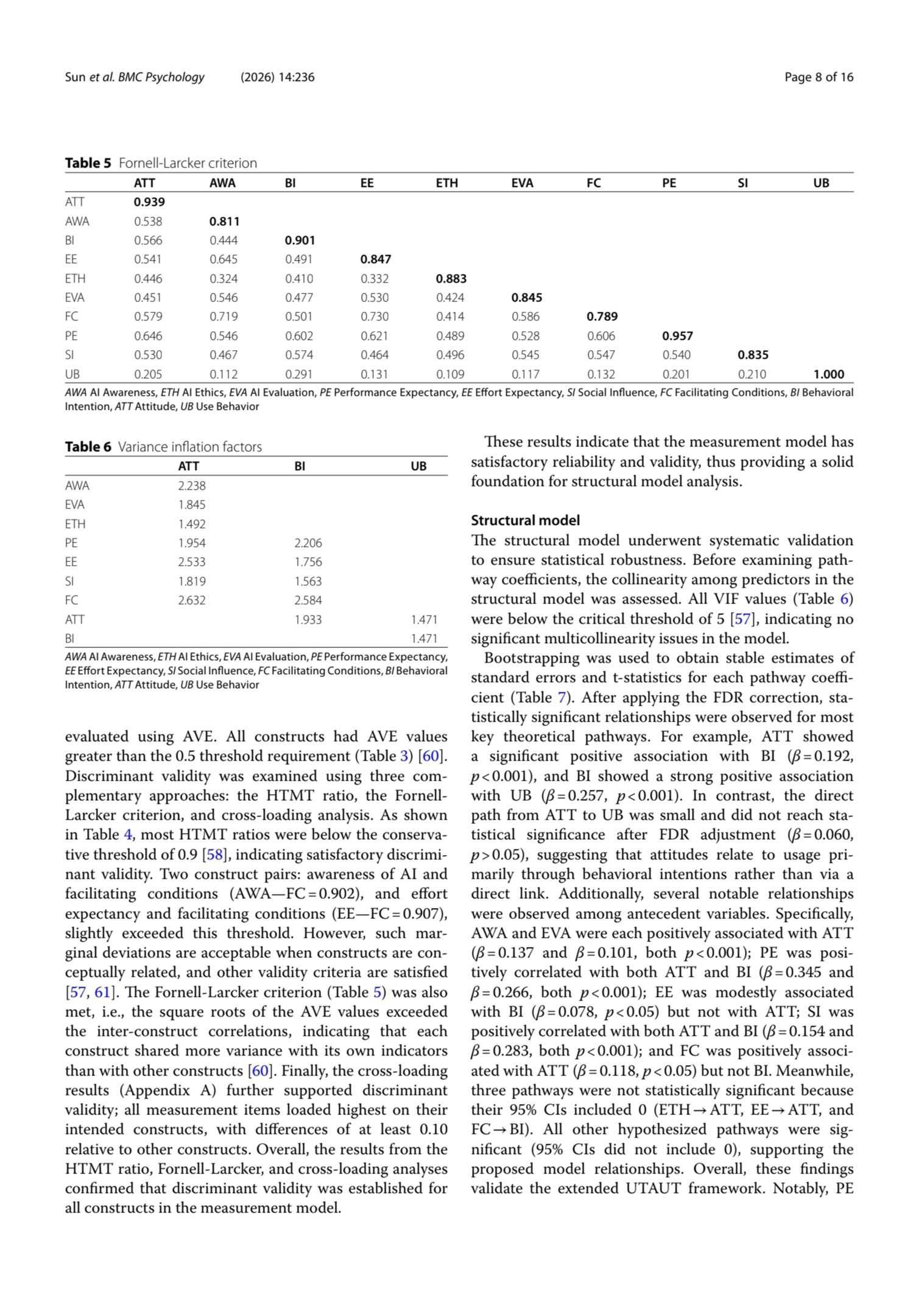
研究方法本研究采用横断面调查设计,通过线上问卷收集了 1536 名中国大学生的数据。测量工具包括经过验证的量表,分别测量 AI 素养(认知、评估、伦理)、技术接受与使用统一理论各构念(绩效期望、努力期望、社会影响、便利条件)、态度、行为意向及使用行为。采用偏最小二乘结构方程模型(PLS-SEM)对假设路径进行检验。
研究结果 绩效期望(β = 0.345,p <0.001)、社会影响(β = 0.154,p < 0.001)和便利条件(β = 0.118,p < 0.05)与学生对生成式 AI 的态度呈显著正相关。绩效期望(β = 0.266,p < 0.001)、努力期望(β = 0.078,p < 0.05)和社会影响(β = 0.283,p < 0.001)与行为意向显著相关。态度与行为意向呈显著正相关(β = 0.192,p < 0.001);而在错误发现率(FDR)校正后,态度对使用行为的直接影响较小且不显著(β = 0.060,p> 0.05);与之相反,行为意向对使用行为表现出较强的正向影响(β = 0.257,p < 0.001)。在 AI 素养各维度中,认知(β = 0.137,p < 0.001)和评估能力(β = 0.101,p < 0.001)与态度呈显著正相关,而伦理维度则表现出不显著的负向关系(β = -0.038,p = 0.148)。该模型对态度的方差解释量为 50.7%,对行为意向的方差解释量为 47.6%。
研究结论 本研究结果表明,人工智能认知、评估能力、绩效期望与社会认可,对于理解学生对生成式人工智能使用的积极评价与行为意向具有重要意义。态度作为核心情感变量,将上述认知评价与学生报告的行为意向联系起来。综合来看,这些研究结论可为高校课程中人工智能素养项目的设计以及支持性学习环境的构建提供参考,即重视理性认知、批判性评估与伦理反思,从而在高等教育中推动学生更具心理认知、更负责任地使用生成式人工智能。
Keywords Generative artificial intelligence, AI literacy, Technology acceptance, Unified Theory of Acceptance and Use of Technology extension, Higher education transformation, Structural equation modeling
关键词:
生成式人工智能;人工智能素养;技术接受;技术接受与使用统一理论扩展;高等教育变革;结构方程模型
原文载于BMC Psychology2026年第14期